
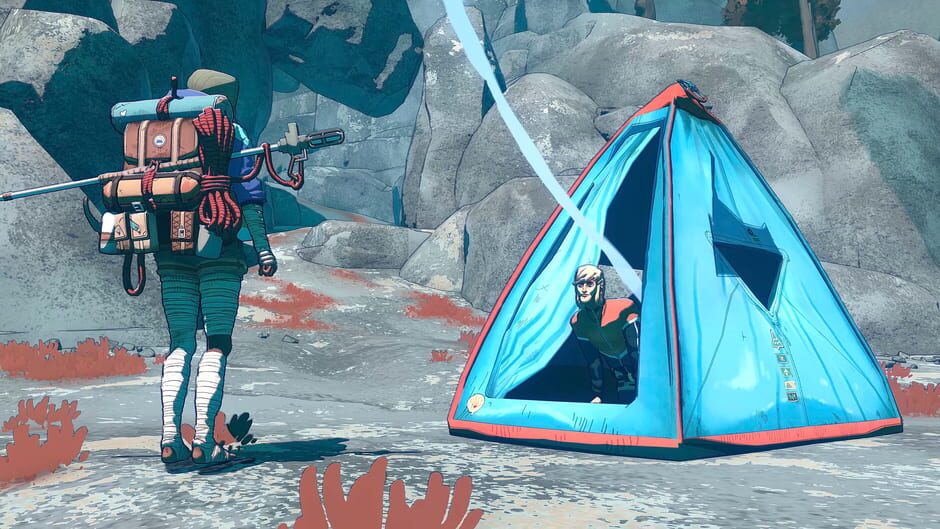
I liked Cairn a lot. You pretty much do nothing else but climb in this game, and they did a great job in making it fun. Cairn is a simple game but well polished, and it offers a nice range of optional challenge that push its mechanics as far as any designer could take them. It’s also a pretty game, with gorgeous handdrawn splash art on load screens and a unique, utilitarian, cel-shaded art style that is perfect for allowing the player visually map out the wall for crags and holds. I was really struck by the awesome performance of the main voice actor(s?), whose grunts, screams, and heartbreaking, desperate whimpers grounded the climbing with realism and stakes. Quickly the tone is set that climbing is SERIOUS BUSINESS, and you are always one step away from critical injury or death. It’s a totally artful wrapping around a game that is proud most of all about its systems, and you can tell every element of the game is designed to work with each other mechanically and narratively. It’s a highly deliberate game, which I admire.
On the other hand, I think Cairn is weighed down a bit by the secondary mechanics and the general inconsistency of player feedback making it hard to strategize and improve at specific skills. Still I think they did pretty much the best job you could making a climbing game, and obviously better than any other climbing game I’m aware of, even my own ha ha. Over time you sort of develop an intuition for what constitutes a solid hold, and how to avoid slipping off, but, honestly, I can’t say that at any point in the game I felt like I had substantially improved at it. A lot of times it really looked like I had a strong hold, but I slipped off anyway - it can be hard to determine if your strategy will pan out, even with practice. I chalk (LOL) this down to a really ambitious mechanic by a studio that doesn’t have the millions to make it perfect. It really does seem at times like magic, too, especially how often the game seems to know which limb you want to move. I probably manually selected a limb one out of twenty times. The belaying is designed in a really interesting way to be a sort of imperfect checkpoint system, as your pitons can break unpredictably (even with perfect installation) and you’ll still take damage from long falls. This was a highlight to me. it’s a really smart way to have the player create their own difficulty. I took pride in free-soloing some routes that I knew I could do without checkpoints, making an otherwise easy climb much more thrilling. I can’t speak to the accuracy to real rock climbing (the only thing I know about climbing is when I did it as a young kid and the movie Free Solo) but I was surprised that they didn’t allow for a few things I have seen real climbers do, like jumping from one position to another, and the climbing under overhangs felt inconsistent at times in a way that makes me feel they didn’t really account for it mechanically despite it being a relatively frequent obstacle. I have a lot of little gripes like this regarding the climbing system, even though it is overall really excellent, because it invites such nitpicking. it’s so intricate and ubiquitous you quickly start feeling all these tiny markers of its internal systems without being able to fully comprehend them. I want to engage more with it at an intellectual level, but the game seems to want you to play more with your intuition. fair enough.
I think the survival mechanics really worked against the spirit of the game without adding much other than a time pressure, a pressure I think works against Cairn’s choose-your-own-path ethos. A few times I personally wanted to take a more challenging route, but I took the easy one anyway as I was running out of resources. There was a section near the end which forced me to turn off the survival mechanics entirely, as I was softlocked by hunger with no food (and no means to get any more). I consider this a major blemish on an otherwise focused work, and the optionality of the mechanic implies to me the designers’ own lack of confidence more than it being purely implemented as an accessibility toggle. I also want to tack on to this point that the consumable buffs sometimes felt cheap in the way that they are wont to do in games, and I often felt like I cheated myself when I could only surpass a difficult route after chugging a few buffs. I can’t quite say it’s cynical of the designers to include these crafting and survival mechanics as the game is already incredibly lean and they are perfectly thematic inclusions, but i just don’t think they were given the same attention to detail.
Vague spoilers this paragraph, though I won’t get into anything specific. I felt personally affected by the story, which is about a skilled but self-destructive obsessive who is not content until she achieves the impossible, a person who isolates from her loved ones in pursuit of personal perfection. The protagonist Aava is, time after time, confronted with her own problems and how her obsession affects others, and each time she chooses herself. There are multiple endings, and they are all delightfully unsatisfying. I think I need to go back to therapy after playing this.